
Thai Past Tense: Yesterday, Already, Yet, and Ever
Thai does not conjugate the verb for past. You add เมื่อวาน, แล้ว, หรือยัง, and เคย. This is the map, with audio.
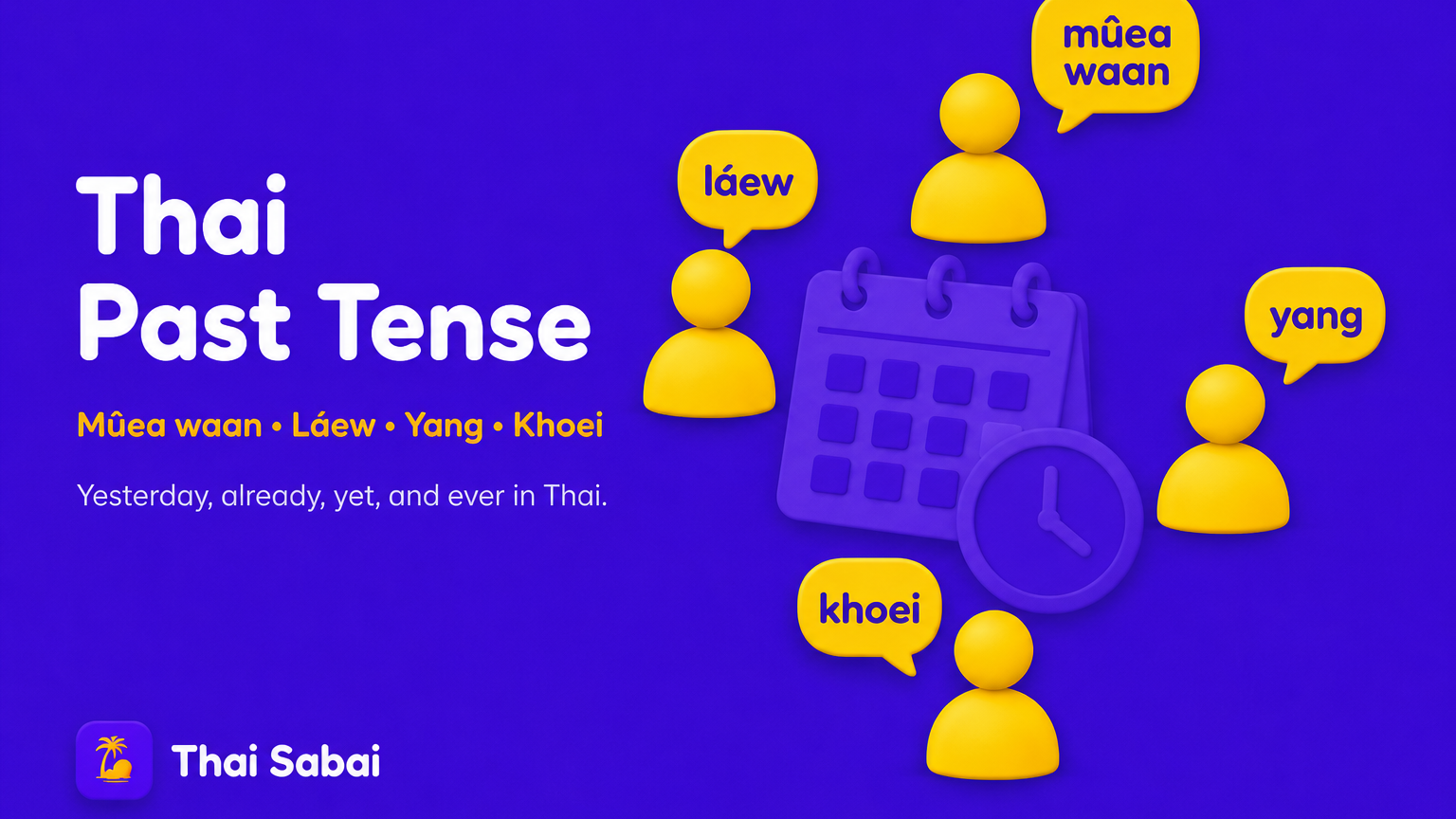
Thai does not have a past tense on the verb. English changes eat to ate. Thai keeps กิน. The verb stays still. You add a time word or a small particle and the sentence is already in the past.
This page is the set you actually need: yesterday I…, I already…, have you… yet / I haven’t yet, have you ever / I have never, and I was… when….
Day-one starter kit
- Yesterday: เมื่อวาน mûea waan
- Already: แล้ว láew
- Yet / ever: หรือยัง / เคย rǔe yang / khoei
Do not change the verb. Add the marker. That is the whole sport.
เมื่อวาน
mûea waan
yesterday
Time word. Put it first. The verb does not change.
แล้ว
láew
already / done
Goes after the verb. Finished, not “in the past” as a grammar class.
หรือยัง
rǔe yang
…yet?
Tag it on the end. กินข้าวหรือยัง is also a greeting.
ยังไม่ได้
yang mâi dâi
haven’t … yet
ยังไม่ได้ + verb. Short answer is just ยัง.
เคย
khoei
ever / used to
Experience. Not yesterday. A lifetime, or at least once.
ตอนที่
dtorn thîi
when / at the time that
Pair with กำลัง…อยู่ for “I was doing X when…”
Thai has no past tense on the verb
กิน is eat, ate, and will eat until you add something else. Context does a lot of work. If you already said เมื่อวาน, you do not also need a special verb ending. There is not one.
So “yesterday I went to the market” is not a new verb. It is เมื่อวาน plus ไปตลาด. Same ไป you use for tomorrow.
The markers below are not tenses. They are jobs: a clock, a “done” stamp, a “yet” check, an “ever in your life” check, and a “while this was happening” frame.
เมื่อวาน (mûea waan): yesterday I …
Put the time at the front. Then the usual sentence. Subject is optional if it is obvious.
Pattern: เมื่อวาน + (I) + verb.
เมื่อวานผมไปตลาด. Yesterday I went to the market. เมื่อวานฝนตก. It rained yesterday. No extra glue.
The family is the same shape. เมื่อกี้ mûea gîi is just now / a moment ago. เมื่อเช้า mûea cháo is this morning (already gone). เมื่อคืน mûea keun is last night. ปีที่แล้ว bpii thîi láew is last year. Same slot. Same unchanged verb.
Yesterday + verb
เมื่อวานผมไปตลาด
mûea waan phǒm bpai dtàlàat
Yesterday I went to the market.
No subject needed
เมื่อวานฝนตก
mûea waan fǒn dtòk
It rained yesterday.
Do not put แล้ว on every yesterday sentence. เมื่อวานผมไปตลาด is already past. แล้ว is a different job.
แล้ว (láew): I already …
แล้ว sits after the verb (or after the whole verb phrase). It means the action is done, or the state has flipped.
Pattern: (I) + verb + แล้ว.
ผมกินข้าวแล้ว. I already ate. กินแล้ว. Ate already. เสร็จแล้ว. Finished already.
That last one is a collocation: เสร็จแล้ว sèt láew is “already finished,” the answer you give when someone is chasing a chore. ไว้แล้ว wái láew is “already done in advance,” like a booking: จองไว้แล้ว.
แล้ว is also “and then” and a soft “so.” ไปตลาดแล้วซื้อผลไม้ is “went to the market and then bought fruit.” If the sentence is a sequence, แล้ว is the hinge, not a past-tense stamp. Listen for that.
Done. Full stop.
ผมกินข้าวแล้วครับ
phǒm gin khâao láew khráp
I already ate.
The chore is done
เสร็จแล้วครับ
sèt láew khráp
Already finished.
เขาแต่งงานแล้ว is often “he is married,” a state, not “he got married five minutes ago.” Same particle. Different English.
เพิ่ง (phêng): I just …
เพิ่ง goes before the verb. Recent. You just did it.
Pattern: (I) + เพิ่ง + verb.
ฉันเพิ่งถึง. I just arrived. ผมเพิ่งกิน. I just ate. Closer than เมื่อวาน. Closer than a vague แล้ว.
You can stack a time word if you need it: เมื่อกี้ผมเพิ่งถึง. A moment ago I just arrived. That is allowed. It is also a lot of clock. Usually เพิ่งถึง is enough.
Just now
ฉันเพิ่งถึงค่ะ
chán phêng thǔeng khâ
I just arrived.
หรือยัง (rǔe yang): have you … yet?
Say the action as normal. Tag หรือยัง on the end. That is the question.
Pattern: verb (+ object) + หรือยัง.
กินข้าวหรือยัง. Have you eaten yet? จองตั๋วหรือยัง. Have you booked the tickets yet? กวาดบ้านหรือยัง. Have you swept yet?
Short answers: แล้ว or เสร็จแล้ว if it is done. ยัง if it is not. You do not need a full sentence. Thai is happy with the particle.
กินข้าวหรือยัง is also small talk. People ask it the way English asks “how are you.” Answer the food question or treat it as a hello. Both work.
ไหม mái can ask a yes/no past thing too: กินแล้วไหม. Have you eaten already? หรือยัง is the “yet” version. Use หรือยัง when the job might still be outstanding.
The yet-question
กินข้าวหรือยัง
gin khâao rǔe yang
Have you eaten yet?
ยังไม่ได้ (yang mâi dâi): I haven’t … yet
ยัง on its own is the short “not yet.” For a full sentence, Thai usually adds ได้ in front of the verb.
Pattern: (I) + ยังไม่ได้ + verb.
ยังไม่ได้กิน. I haven’t eaten yet. ผมยังไม่ได้ทำการบ้าน. I haven’t done my homework yet. ฉันยังไม่ได้จองตั๋ว. I haven’t booked the tickets yet.
ยังไม่ without ได้ sits in front of an adjective or a “done” word: ยังไม่เสร็จ (not finished yet), ยังไม่สะอาด (not clean yet). Action you have not got round to: ยังไม่ได้ + verb.
The not-yet answer
ยังไม่ได้กินค่ะ
yang mâi dâi gin khâ
I haven’t eaten yet.
Do not mix this with ไม่เคย. ยังไม่ได้กิน is “not yet, but maybe later today.” ไม่เคยกิน is “I have never eaten that, period.”
เคย (khoei): have you ever …
เคย is experience. Have you ever. Used to. At least once in your life. It is not “yesterday.”
Pattern: (you) + เคย + verb + ไหม.
คุณเคยไปเชียงใหม่ไหม. Have you ever been to Chiang Mai? คุณเคยกินทุเรียนไหม. Have you ever eaten durian?
เคย goes before the verb. ไหม on the end makes it a question. Answer เคย if yes. You can add แล้ว: เคยแล้ว. Been there.
The ever-question
คุณเคยไปเชียงใหม่ไหม
khun khoei bpai chiang mài mái
Have you ever been to Chiang Mai?
If you mean yesterday, use เมื่อวาน. เคยไปเมื่อวาน is not how you say “I went yesterday.” เคย is the wrong shelf.
ไม่เคย (mâi khoei): I have never …
Same slot. Negative.
Pattern: (I) + ไม่เคย + verb.
ผมไม่เคยไป. I have never been. ฉันไม่เคยกินทุเรียน. I have never eaten durian. ไม่เคยเลย if you want to lean on it.
Never, not “not yet”
ผมไม่เคยไปครับ
phǒm mâi khoei bpai khráp
I have never been.
กำลัง … อยู่ and ตอนที่: I was … when …
English “I was eating when he called” is two pieces in Thai.
กำลัง gamlang + verb + อยู่ yòo is the “in the middle of” frame. It is also how you say you are doing something right now. The past comes from ตอนที่ or from a time word.
ตอนที่ dtorn thîi is “at the time that / when.”
Pattern: กำลัง + verb + อยู่ + ตอนที่ + [the other thing].
ผมกำลังกินข้าวอยู่ตอนที่เขาโทรมา. I was eating when he called.
You can flip the clauses: ตอนที่เขาโทรมา ผมกำลังกินข้าวอยู่. Same meaning. Put the “when” bit first if you want the interruption to land first.
ตอนนั้น dtorn nán is “at that time.” เมื่อวานตอนที่ฝนตก ผมอยู่บ้าน. Yesterday when it was raining I was at home. You do not need กำลัง if you are just locating yourself. You need กำลัง…อยู่ when the action was in progress.
Do not translate was as เป็น. ผมเป็นกินข้าว is not a sentence.
In progress, then interrupted
ผมกำลังกินข้าวอยู่ตอนที่เขาโทรมา
phǒm gamlang gin khâao yòo dtorn thîi khǎo thoo maa
I was eating when he called.
Extra time words that do the same job
These sit in the เมื่อวาน slot. Verb still does not change.
ได้ dâi before a verb can mark that something really happened, often in writing or when you are being a bit official: ผมได้ไปแล้ว. You will hear it. You do not need it for “yesterday I went to the market.” Start with เมื่อวาน and แล้ว.
จะ ja is the future marker. Leave it off the past sentences. เมื่อวานผมจะไปตลาด is “yesterday I was going to go,” a plan, not a trip you took.
What not to do
Do not conjugate the Thai verb. There is no -ed.
Do not stamp แล้ว on every past sentence. Yesterday already did the job.
Do not use เคย for a thing that happened yesterday. เคย is ever / used to.
Do not use ไม่เคย when you mean ยังไม่ได้. Never and not-yet are different shelves.
Do not translate I was as ผมเป็น + verb.
Start with เมื่อวาน, verb + แล้ว, หรือยัง / ยังไม่ได้, and เคย / ไม่เคย. Add กำลัง…อยู่ ตอนที่ when you need two things happening at once. That is enough past tense for a long time.